After nine years as Bishop of the Diocese of St George’s-in-Grenada, and 50 years in priesthood, Bishop Clyde Harvey says he leaves office with “tremendous hope” for the church in Grenada—even as he admits to disappointments and unfinished work.
In a wide-ranging interview aired Thursday, February 19 on the Good News Catholic Communications platform, the fifth bishop of St George’s reflected candidly on his unexpected appointment, the challenges of leading the Church in Grenada, and the legacy he leaves behind.
Bishop Harvey recalled the moment in 2016 when he was summoned by then Apostolic Nuncio, Archbishop Nicola Girasoli. “He said, ‘The Pope, Pope Francis wants to appoint you as bishop of St George’s-in-Grenada’.” Though rumours had circulated, Bishop Harvey admitted his heart was set on continuing ministry in Trinidad. But the Nuncio was direct. “The pope isn’t asking you know, he’s telling you.”
Within minutes of prayer in the chapel, he was instructed: “Write a letter to the pope in your own handwriting saying that you accept.” Grenada had been without a bishop for a year. Instead of the customary three months to prepare for ordination, he was given six weeks. “You know, I said, ‘Wow’.”
Yet, Bishop Harvey said, signs confirmed the decision. As he worked on his coat of arms and reflected on his connections to Grenada, “I realised everything was coming together and that said to me that the Spirit was at work.”
A Church in transition
Bishop Harvey entered a diocese still grieving the death of Bishop Vincent Darius OP and adjusting after a year without leadership. “You were like sheep without a shepherd,” he told host Ruthina Victor. He admitted, however, that he underestimated the depth of the challenges. “My biggest disappointment…was that I was not told certain things when I came. I was not made aware that a lot of my own perceptions were wrong, very wrong,” he said.
He revealed that when he was appointed bishop, the Church had an EC$600,000 debt.
He said he assumed a shared understanding of priesthood among clergy, only to later discover otherwise. “I had to try and understand the men whom I had to work with and that took quite a while.”
Covid-19 further complicated efforts at renewal just as he began to grasp the diocesan realities. One of his earliest shifts was leadership style. “Before a bishop coming into a diocese, he’d gather himself a few priests around him and he’d run the diocese. And I had six people around me, just one priest.”
Empowering lay Catholics was central to his vision. “That for me was a very, very important thing.” He acknowledged that many Catholics preferred a directive model.
“When you were asking about how do we do this, how do we bring this together and so on, people just shut up.” He insisted that growth requires change. “Repent doesn’t mean go to Confession and say your prayers. Repent means change your thinking, change your mind.”
Quoting St John Henry Newman, he added, “To live is to grow. If you’re not growing, you’re not living.”
In one of the more pointed moments of the interview, Bishop Harvey said he does not believe Grenada is yet a Christian country. “I make no apologies for saying it.”
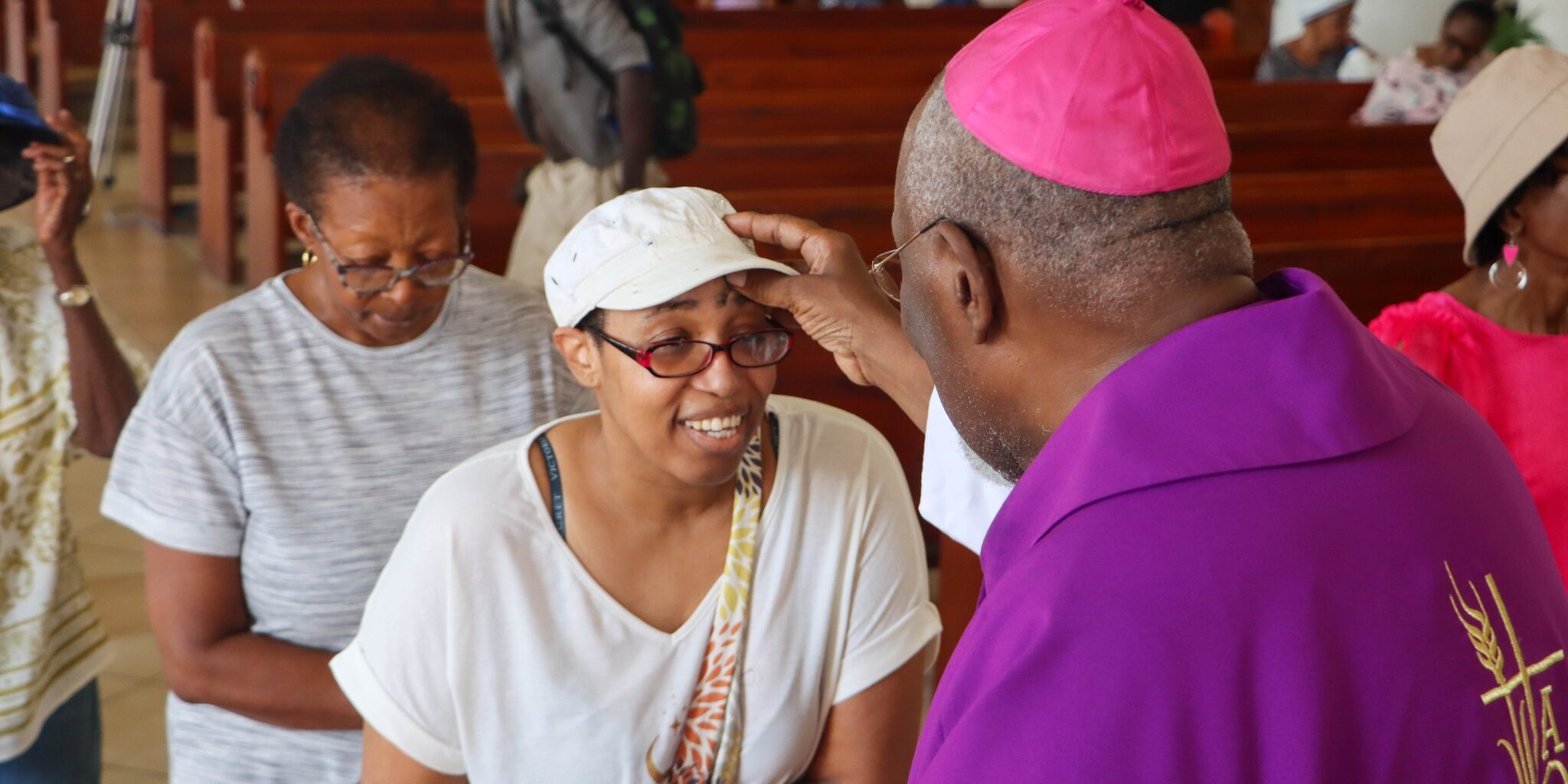
Referencing the recent murders of two young women, he said the tragedies deeply affected him. “It was yesterday, during the Ash Wednesday ceremonies, that I realised how deeply pained I was by the whole thing.”
Quoting Rabbi Abraham Heschel, he stressed shared responsibility: “Some are guilty, all are responsible.” He admitted frustration at what he sees as a culture of blame. “Everybody else is to blame. Not us.”
On criticism and public attacks
The Bishop also spoke about personal criticism, including being insulted publicly. Yet he said hardship deepened his commitment. “Christianity and the priesthood of Jesus Christ is not about being loved… Christianity is about doing the will of the Lord wherever the Lord puts you.”
Drawing a parallel with marriage, he said: “It is through the difficulties that you come to the depths of intimacy.”
On vocations, Bishop Harvey admitted limited progress. He said he deliberately avoided recruiting foreign candidates seeking transfer and insisted that priesthood must emerge from parish life.
“I went to Rome in 2018 and the cardinal who was responsible for this area, he said to me, ‘do not take any priest or anybody wanting to be a priest who is not willing to be a priest in the diocese of his birth’.”
Addressing global sexual abuse scandals, he said he has not seen them as the primary obstacle to vocations locally. Instead, he pointed to lack of support for clergy. “I’ve heard it often enough for me to know there’s a point here…they did not get the support of their own people.”
He urged parishioners to engage priests directly when issues arise. “Go and talk to him. Write the bishop.”
Catholic education remains unfinished business. “If we are to do the work we have to do in education, my initial estimate, it will cost about $10 million EC. And where is that $10 million coming from?” He said evangelisation in schools must increasingly be peer driven. “It has to be done by children. Children evangelising children.”
He also warned that the Church must confront artificial intelligence thoughtfully. “We are forming human beings, we not forming robots of AI.”
Asked about his legacy, Bishop Harvey resisted self-assessment. “I leave that for God and Grenada to judge.” He confirmed he would be leaving Grenada because he doesn’t believe that an outgoing bishop “should be looking over the shoulder of an incoming bishop.”
He said he plans to return to Trinidad or go to the US.
By Kaelanne Jordan