JAMAICA
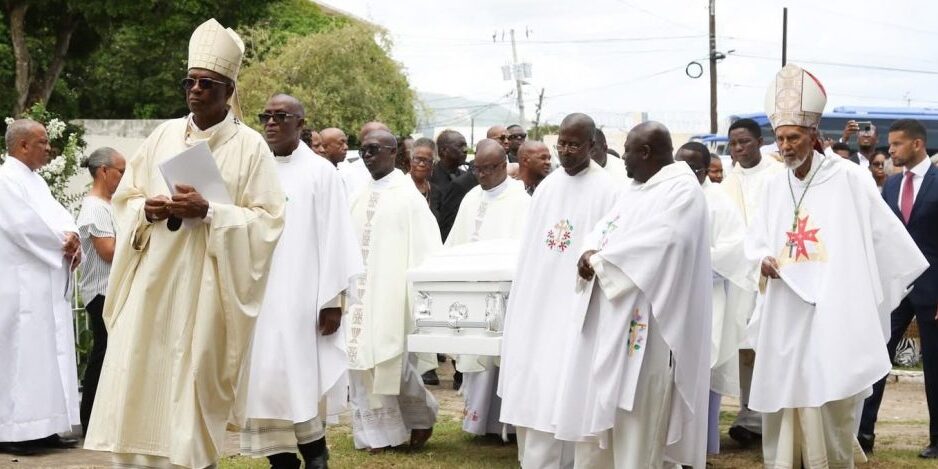
Regional Catholic leaders and clergy, government officials and mourners gathered Saturday, April 18 at the Cathedral of the Most Holy Trinity for the Mass of Christian Burial of Bishop Burchell Alexander McPherson. Bishop McPherson, a beloved figure in the Catholic Church died March 25. He served as Bishop of the Diocese of Montego Bay from 2013 until his resignation in 2023.
Delivering one of the main tributes, Archbishop Charles Jason Gordon, President of the Antilles Episcopal Conference (AEC) said that the Caribbean Church “has lost not only a devoted shepherd but a singular and unforgettable witness of the gospel,” describing Bishop McPherson as “one whose humanity, authenticity and faith was woven together in a way that made him truly a son of the Caribbean soil.”
Archbishop Gordon said Bishop McPherson carried his episcopal ministry not as an external dignity, but as an interior calling rooted in who he was as a Maroon descendant, “a Jamaican man of deep faith, cultural richness and pastoral heart.”
Bishop McPherson, the Archbishop underscored, embodied a Church that was incarnate, grounded, and close to the people.
The Archbishop highlighted both the late Bishop’s character and his unmistakable personality, recalling one brother bishop’s first meeting with him for the Ad Limina visit in Rome.
“And while others were dressed in clerical attire, Burchell stood out clad in dungarees, a simple t-shirt, utterly at ease in his own skin. And with a warm humour, he welcomed his brother and remarked ‘We belong to the same B club: big, black, bold, and bishop.’ And that’s Burchell,” Archbishop Gordon said.
Apostolic Nuncio Archbishop Santiago De Wit Guzmán read messages of condolence from the Vatican, including those from Pope Leo XIV, the Cardinal Secretary of State, and the Prefect of the Dicastery for Evangelization.
In the homily, AEC General Secretary, Jamaican priest Fr Donald Chambers, reflected on the spiritual imagery of fire, quoting Scripture, Jeremiah 19:7–9 “There seemed to be a fire burning in my heart, imprisoned in my bones, a fire.”
He described Bishop McPherson’s ministry in vivid terms, saying, “Bishop Burchell was a bushfire. Don’t you agree with me? He was a big, black, bold bush fire. Why? Not because of himself, but because of the Holy Spirit.”
Fr Chambers believed that Bishop McPherson’s greatest legacy to Jamaica and to the Jamaican church was the human and pastoral ingredients he contributed to synodality.
He said that as he reflected on Bishop Burchell’s life and the symbols on his coat of arms, he experienced an epiphany that the three pillars of synodality: communion, participation and mission, were all reflected in those symbols.
“The open hands speak of authentic communion with God and people. The Abeng [a indigenous side-blown horn] speaks of calling all people to participate in discerning God’s will and making decision. The fire speaks of mission, a mission on fire with God’s Word.”
Fr Chambers continued, “And so, Bishop Burchell never studied synodality. But guess what? He lived synodality.”
Relationship was also an essential part of Bishop Burchell’s ministry.
“He created a relational Church, a relational community. He related intimately not only with those within his circles as the testimonies have told us, but he also related in a particular way to the marginalised,” Fr Chambers said.
Church leaders also spoke to his deep personal connection with people. Archbishop Kenneth Richards of Kingston said, “everyone would think that I’m Burch’s best friend,” adding that “everyone had a personal affection that emanated from Bishop Burchell that make them feel comfortable in his presence.”
Among those present were Senator Donna Morris Dixon, Minister of Education, Skills, Youth and Information representing the prime minister, and Opposition Leader Mark Golding.
In closing, Bishop John Persaud of Mandeville announced a memorial service for Bishop Burchell in Montego Bay at the Cathedral, May 16.