AEC Bishops (Archbishop Charles Jason Gordon)
May 2026
Nobody warned us about the pickleball.
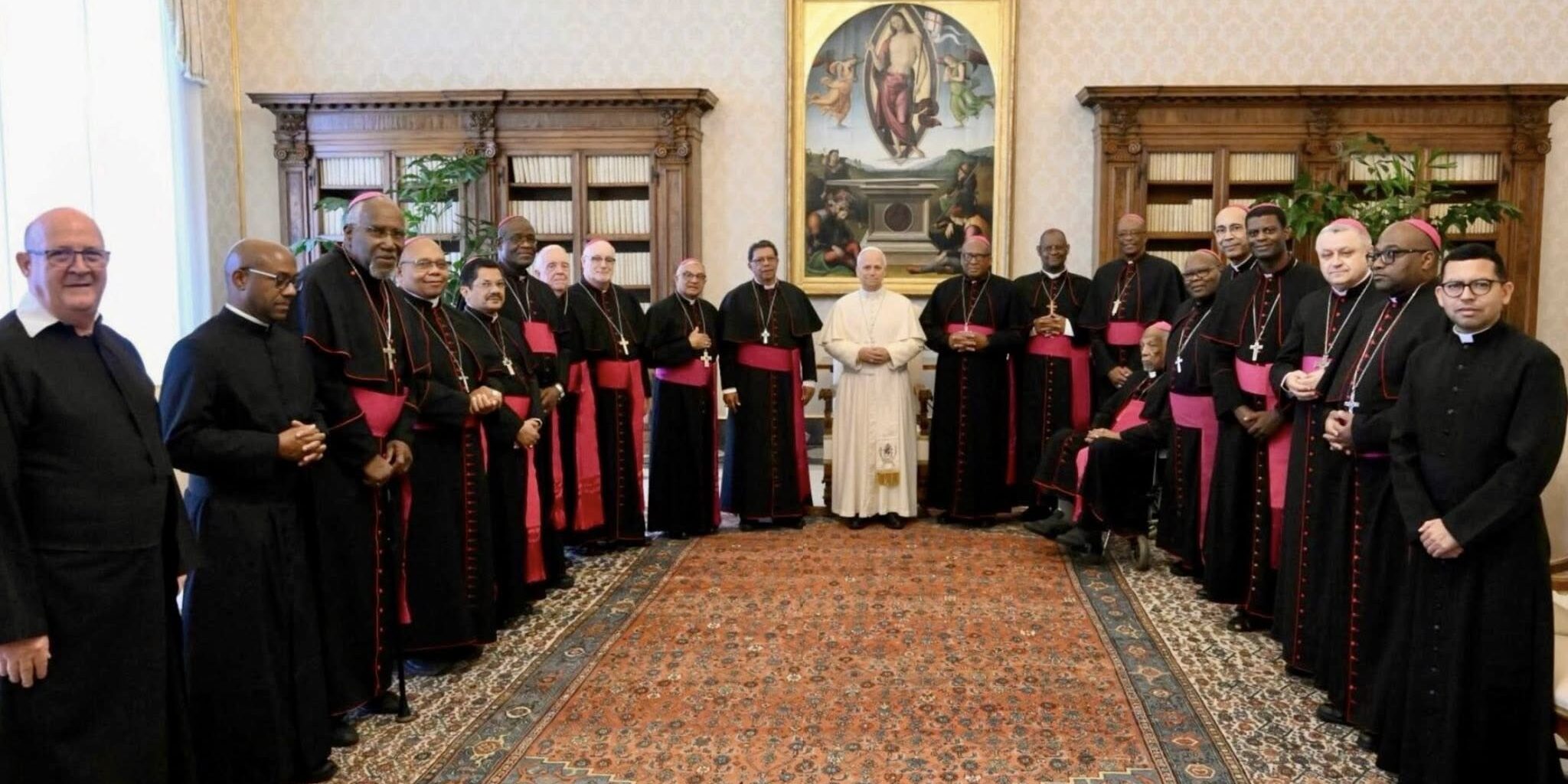
We had come to Rome as the bishops of the Antilles Episcopal Conference — eighteen bishops, one diocesan administrator, and two general secretaries — carrying the weight of our people: the geopolitics that threatens our peace, the parishes stretched thin by poverty, the migrants knocking on their door, the families battered by storms. We had prepared our addresses. We knew what an ad limina visit was. And then, somewhere in the middle of nearly two hours with Pope Leo XIV, the conversation turned to sport. Tennis first. Then pickleball.
And the Pope lit up.
I have been thinking about that moment ever since — not as a footnote, not as the charming human detail you tuck at the end of a report to soften it, but as a key. A small, unexpected thing that unlocks the meaning of everything around it. Because a man who can receive a question about pickleball with genuine delight, in the middle of a conversation about hurricanes and missionaries and the future of the Church, is a man who is not performing. He is not managing the meeting. He is simply present. Free.
And it was that freedom — that ease in his own skin — that made everything else in the room possible.
A Latin American Pastor
To understand what we encountered, you have to understand where this man was formed. Robert Francis Prevost is often introduced as the first American pope. That is true, but only half the story. He is, far more deeply, a Latin American pastor. He spent decades in Peru and served as a bishop in Chiclayo. He was shaped by the Aparecida Document — that luminous text from the 2007 conference of Latin American bishops, which called the Church away from self-preservation and toward missionary discipleship: going out to share the encounter with Christ with others, especially on the peripheries. Pope Francis carried that vision to Rome. So, in his own register, does Leo XIV.
You feel it in the way he conducts a meeting.
He Opened the Session
When the formal portion of our audience concluded, he did not close the session. He opened it. He invited us into conversation — not consultation, not Q&A, but the kind of exchange where someone genuinely wants to know what you have seen and what you are carrying. In our address we had asked him to visit our region. He responded with a question: had a pope ever visited the Antilles? We told him about John Paul II — Jamaica, the Bahamas, Saint Lucia, Trinidad and Tobago. No pope had returned since. He received that not as data to be filed but as a reality to be held.
Two days after our visit, we received an answer to another question we had raised — better representation at synodal meetings in Rome. At the General Secretariat for the Synod of Bishops, Cardinal Mario Grech told us that the Holy Father had personally instructed him to give us fuller participation in the upcoming synod. He had not merely listened — he had heard, and acted.
Three things emerged as close to his heart. First, the interior life of the bishop — he used the image of soil, a field that must be tended, because ministry grows from the depth of the roots. Then the family, the living cell where the Church breathes or suffocates: stay close to families, do not leave them to navigate alone what no family can navigate alone. And Catholic education: be careful before you close anything. Schools are not buildings. They are the future.
He Let the Weight Land
Then one of our brothers spoke. His diocese had been devastated by Hurricane Melissa. He named it plainly — the destruction, the exhaustion, the long road still ahead, the gratitude for solidarity received, and the honest truth that solidarity, however generous, does not rebuild what a storm takes. Pope Leo did not rush to reassure him. He did not reach for a phrase. He listened. He let the weight of it land. In that stillness I witnessed the Aparecida instinct of accompaniment — walking with people in their reality rather than administering responses to their problems.
On synodality, the bishops pressed him: what does it actually mean on the ground in a region like ours? He was clear and unhurried. Synodality is not democracy — the Church does not govern by vote. But neither is it uniformity. It is something more demanding: learning to listen together, across difference, for the voice of the Spirit.
We raised the growing presence of missionaries from Africa and Asia in the Caribbean — the gifts they bring, and the difficulties when formation does not prepare them for our context. He engaged it with unexpected tenderness: the missionary who comes has left his security behind and is cut off from his own people and culture. A new initiative of the Dicastery for the Evangelisation of Peoples, he told us, would address precisely this — deeper formation before sending, and greater responsibility on receiving dioceses to accompany missionaries on arrival.
And Then, Pickleball
And then, tennis. And pickleball.
I cannot tell you exactly how we arrived there. These things happen in conversations that are truly alive. But I can tell you what it revealed. Aparecida does not produce cautious, managed pastors. It produces people freed by encounter — who know that the Gospel is not a burden to be administered but a joy to be shared, carried in their laughter, in their willingness to be surprised. Holiness does not make a person smaller. It makes them more present, more alive, more capable of meeting you where you are.
We Came Home Carrying Something
We came home carrying something I want to offer you. Not a protocol summary. A witness. We met a pastor shaped by Latin America’s poor, by decades on the periphery, by the Augustinian restlessness that only finds rest in God — one who asked before he spoke, listened before he answered, and received the reality of our people without softening it prematurely.
His first words from the balcony last May were simple: “Peace be with you.” They were not a sentiment. They were a report from someone who has found it. We came home carrying a little more of it.