A decade on, the language of accompaniment has become the Church’s ordinary speech. The harder work—forming families who send others to Christ—has only begun.
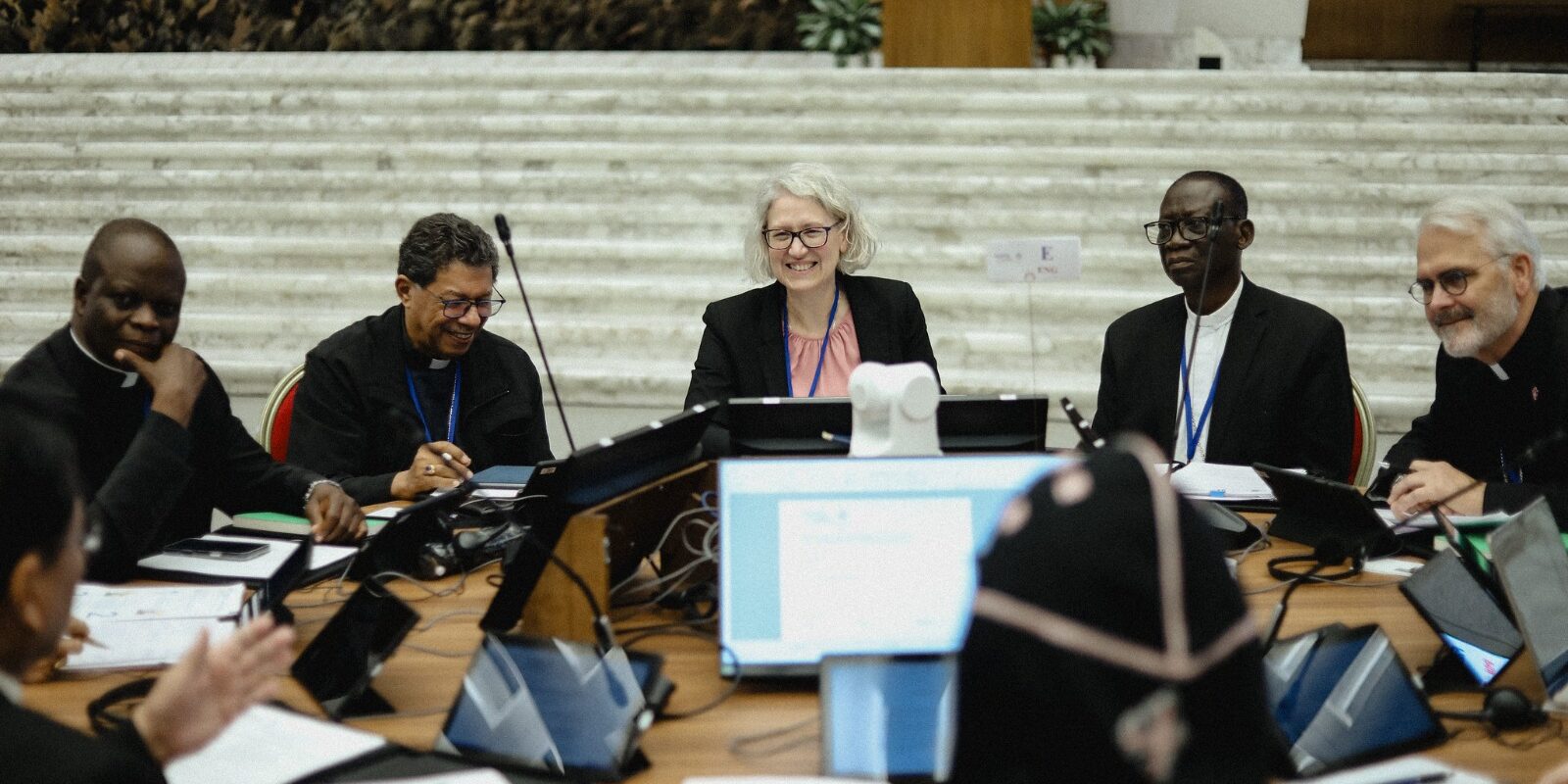
I spent a week in Rome at a gathering Pope Leo XIV convened to mark ten years since the late Pope Francis gave the Church Amoris Laetitia. On the first morning, before any papers were read, we sat with a woman carrying an empty jar to a well at noon.
Some ten years ago, the Church was wrestling with a hard question: what do we do with Catholics whose lives do not match our teaching on marriage? We thought of the divorced and remarried and of couples living together.
In the Caribbean, we would add the visiting union, the long common-law partnership, the household held together by a grandmother while a parent works in Toronto or Brooklyn.
Pope Francis widened the question: couples married in the Church also need accompaniment. A sacramental marriage can be valid and still struggle—with communication, forgiveness, intimacy, money, raising children, or the slow daily cost of sacrificial love.
The real question was how we accompany every couple and every family towards the fullness of their vocation. That was the paradigm shift.
From categories to pilgrimage
For too long, our pastoral imagination was trapped in categories: good Catholics and bad Catholics, good marriages and failed ones, those in grace and those in sin.
We cannot wave away these distinctions; our choices carry real spiritual weight. But Pope Francis asked us to begin somewhere deeper—to see every family as a pilgrim on the way to love, communion and holiness.
Marriage is not simply a legal arrangement, nor only a sacrament celebrated on one Saturday afternoon. It is a vocation, a lifelong school of love, a path to sanctity. Every family is called to become what the Second Vatican Council named a domestic Church (Lumen Gentium 11), a home where Christ is met and the Gospel is lived around the table.
Some families are further along that road. Some live in situations that do not yet correspond to the Church’s sacramental vision. None is beyond God’s mercy—and none is beyond the Church’s care.
That is why the eighth chapter of Amoris Laetitia is titled ‘Accompanying, Discerning and Integrating Weakness’. The starting point is no longer the classification of a family. It is the conviction that God is already at work in it.
Five movements in Rome
Our week followed five conversations. We began with the family as it is—in its beauty and its strain. For us in the Caribbean that means the matrifocal household, the grandmother raising ‘barrel children’ anxiously waiting for what their parents send home from abroad, and the couple who have stayed faithful for decades without ever reaching the altar.
We turned next to young people and the discovery of marriage as a vocation. How do we help a young man in Laventille or a young woman in Castries see marriage not as a social expectation or a romantic dream, but as a call from God that needs discernment and formation?
The third conversation took up the first years of marriage—decisive years, often lived with little help once the wedding photographs are printed.
The fourth brought us to families in difficulty and to complex marital situations, where mercy, truth, discernment and belonging pressed hardest. Finally, we considered families as subjects of the Church’s mission, not only recipients of pastoral care—evangelisers in their own right.
Reality, vocation, formation, wounds, mission: the order was itself a road.

Photo: Vatican News
The woman at the well
The Samaritan woman (Jn 4) walks that same road in a single afternoon. She comes at noon with an empty jar and a hard life. She meets a stranger who speaks of living water, and her thirst becomes a question about God. She begins to see a prophet, then perhaps the Messiah.
Then comes the wound. Jesus names the truth of her life: five husbands, and the man she now lives with is not her husband. He neither humiliates her nor pretends it does not matter. He brings the truth into the light inside an encounter of dignity and grace.
Pope Leo asked us in his opening address: “What kind of Church, then, do people encounter precisely when they are most fragile?” At the well, the answer is a Church that looks like Christ—truthful, unhurried and merciful.
Then comes mission. She leaves her water jar and runs to the town: “Come and see a man who told me everything I have ever done!” Soon the town believes because it has heard Him.
Here is the deeper logic of Amoris Laetitia. We accompany people not merely so they feel welcome, but so that they meet Jesus Christ, receive His truth and mercy, grow in love—and go and tell others.
A new pastoral culture
“We certainly have much to learn from families,” Pope Leo told us. That sentence, like the words accompaniment and discernment, might have sounded strange ten years ago. Today they belong to the ordinary vocabulary of the Church.
I came home convinced that marriage is a vocation, that couples need accompaniment long after marriage preparation ends, and that families in difficulty must never be abandoned.
Not every question is settled. Theological, moral and canonical questions remain—above all, around sacramental discipline and the integration of Catholics in irregular unions. Honesty requires us to say so.
Yet something fundamental has shifted. Accompaniment is no longer an emergency ministry for families in crisis. It is the Church’s normal responsibility towards every family.
We go to the peripheries for those who feel shut out, and we keep marriage and family at the centre of the Church’s life. Periphery and centre are one pastoral vision.
From accompaniment to mission
The task of the next decade is to move beyond accompaniment as support towards transformation.
A family that meets Christ grows in communion. A couple that learns to forgive becomes a living sign of reconciliation. Parents who pray with their children become the first evangelisers of the next generation. And families who have tasted God’s mercy in their own brokenness often become the most credible witnesses to others who are struggling—the couple down the road, the neighbour who stopped coming to church.
Pope Leo was clear on this, saying, “families bear witness to the Gospel and contribute to the life and the mission of the Church.” Love, by its nature, spills over. The journey does not end when a family receives care; it matures when that family begins to give it.
The work now is to deepen this new pastoral culture; to form priests and pastoral leaders in its practice, to walk with couples across a lifetime, and to help every family discover its call to holiness and mission.
Our success will not be measured by how many families we accompany, but by how many meet Christ, grow in love and become missionary disciples.
The Samaritan woman did not stay at the well. She went out. So must our families.
Key Message:
Accompaniment is not an exceptional ministry for families in trouble—it is the Church’s ordinary care for every family, and its goal is families who meet Christ and become missionaries of His love.
Action Step:
This week, pray together as a family for one couple whom you know is struggling, then find a simple way to stand with them—a visit, a meal, a phone call.
Scripture for Reflection:
“Then the woman left her water jar and went back to the city. She said to the people, ‘Come and see a man who told me everything I have ever done! He cannot be the Messiah, can he?’” (John 4:28–29)
V