By Fr Donald Chambers
The transmission of faith has always been at the heart of the Church’s mission. From the first disciples gathered around Jesus to Christian communities across the Caribbean today, the Church exists so that each generation may encounter Christ and pass that encounter on to the next.
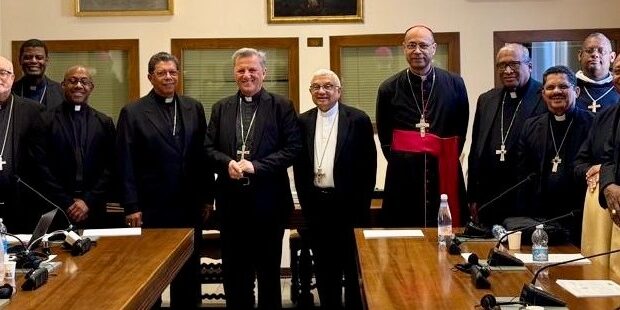
Yet as the Church embraces synodality, some have mistakenly treated it as the goal. The recent ad limina visit of the bishops of the Antilles Episcopal Conference to Rome offered an important clarification that synodality is the vehicle. The mission remains the transmission of the faith.
During their meeting with the Dicastery for the Doctrine of the Faith, Cardinal Víctor Manuel Fernández posed a central question to the bishops: how is the faith in Jesus Christ transmitted today in the Antilles?
The question arose from a growing awareness that many traditional channels of faith formation, especially the family and Catholic schools, are no longer as effective as they once were.
Cultural fragmentation, secularisation, migration, digital media, and economic pressures have weakened many of the structures that previously sustained Christian identity.
Yet the Cardinal insisted that the Church has too often focused on teaching doctrine and moral rules, neglecting how faith is communicated. Faith is not transmitted merely through information. It is transmitted through encounter, witness, relationship, and community. The kerygma, the joyful proclamation that Jesus Christ loves, saves, and accompanies us, must once again be central.
This insight is closely connected to synodality. Synodality is fundamentally a way of being Church, rooted in listening, participation, communion, and shared mission.
During the bishops’ dialogue with the Secretariat of the Synod, Cardinal Mario Grech reminded them that synodality is a lived experience that requires practice and conversion. Synodality teaches the Church to walk together, listen deeply, and create spaces where people encounter Christ through authentic relationships.
But we must be careful not to confuse the method with the mission. The Church’s mission remains evangelisation: the transmission of faith from one generation to another. Synodality enables this mission by creating the conditions for faith to be credibly received, experienced, and lived. In many ways, synodality is the renewed pastoral style needed to communicate the Gospel in a fragmented world.
This became evident throughout the ad limina conversations. The bishops repeatedly returned to the importance of authentic community. One bishop observed that some Catholic men had experienced stronger fraternity and a sense of belonging in secular organisations than in parish life.
That observation should trouble every parish community. If people cannot encounter communion within the Church, the Church’s proclamation of Christ loses credibility.
The Gospel cannot be transmitted effectively in isolated or impersonal communities. Synodality addresses this challenge directly. It invites parishes, schools, and dioceses to become spaces of encounter rather than merely administrative or sacramental centres.
It seeks to move the Church from maintenance to mission, from passive reception to active participation, and from clerical isolation to shared discernment.
Yet all of this matters only insofar as it serves the greater purpose of helping people encounter Jesus Christ.
Pope Leo XIV reinforced this perspective during the AEC bishops’ audience with him. Reflecting on synodality, he clarified that it is neither democracy nor uniformity, but a way of being Church in which diverse members listen together for the voice of God.
The Holy Father consistently linked this synodal vision to the Church’s pastoral mission: supporting families, strengthening Catholic education, accompanying priests, and nurturing missionary disciples. Synodality was never presented as an end in itself but always connected to the Church’s evangelical mission.
The Dicastery for Communication offered another important insight. Communication, they explained, is not fundamentally about technology or media platforms but about relationships and encounters. In the digital age, the Church cannot simply broadcast information; it must communicate in ways that foster communion and human connection.
Again, the emphasis is not on methods alone but on fostering meaningful relationships with Christ and one another.
For the Caribbean Church, this clarification has significant implications. In our enthusiasm for synodal formation, consultations, and discernment, we must constantly ask: how does this help us transmit the faith?
If synodality becomes disconnected from evangelisation, it risks becoming another ecclesial exercise without transformative power. The transmission of faith requires communities that radiate joy, belonging, credibility, and hope.
It requires bishops, priests, Religious, and laity who authentically witness to Christ in both personal and communal life. It requires liturgies that foster encounter, catechesis rooted in relationship, and parishes capable of genuine communion.
Synodality makes this possible by renewing the Church’s relational fabric. It teaches us to listen before speaking, to discern before acting, and to walk together rather than alone.
In a fragmented world, this synodal style becomes a prophetic witness. The mission entrusted by Christ remains the same: to proclaim the Gospel and make disciples. Synodality is the path by which the Church seeks to fulfil that mission today.