By Fr Donald Chambers
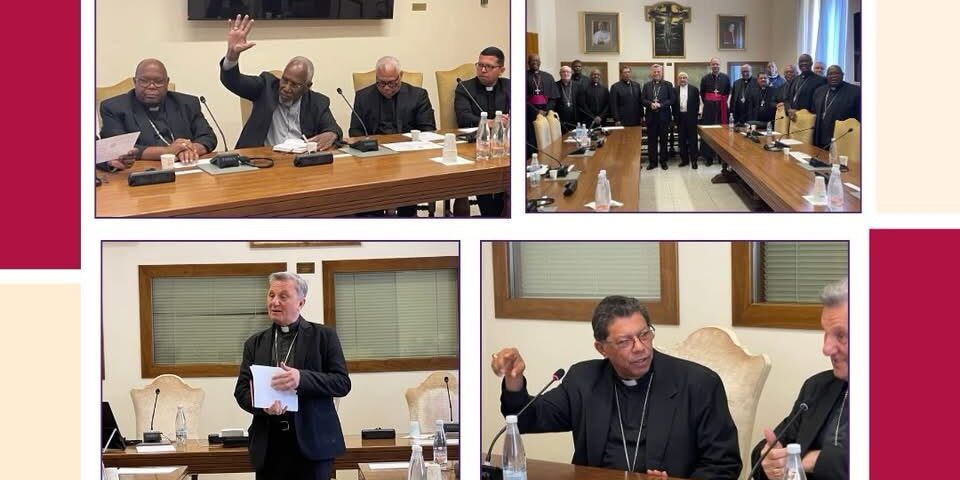
When the bishops of the Antilles Episcopal Conference (AEC) journeyed to Rome for their ad limina visit in late April 2026, they entered not merely a series of formal meetings but a lived experience of what synodality looks like when taken seriously.
Across encounters with Vatican dicasteries or departments and with Pope Leo XIV himself, a consistent pattern emerged: conversations marked by listening, mutual respect, and a shared search for the voice of the Spirit.
From the outset, the tone was markedly synodal. At the Secretariat of the Synod, the meeting began with a contemplative check-in with the bishops, setting the stage for an exchange rooted in attentiveness to God and to one another. What followed was not a one-way presentation but a dialogue in which Cardinal Mario Grech, his team and the bishops listened and learned together.
This synodal style permeated every encounter. Whether discussing clergy formation, evangelisation, safeguarding of minors, or interreligious dialogue, the approach remained consistent, attentive listening, honest naming of tensions, and a willingness to dwell with complexity rather than rush to quick solutions. As Archbishop Charles Jason Gordon wrote (CN, May 10), the audience with Pope Leo XIV embodied this spirit most vividly. After formal remarks, the Holy Father opened a free and fraternal conversation.
His reflections on the interior life of bishops, the fragility of family life, and the importance of Catholic education were not abstract directives but invitations to deeper discernment. The encounter became a lived expression of a Church that listens rather than speaks.
Beyond the style of engagement, several themes emerged consistently, offering insight into the Church’s direction. A central insight was that synodality is demanding. It cannot be reduced to structures or documents but requires ongoing conversion.
At the Synod Secretariat, it was emphasised that what is needed is not more texts but sustained practice. While the AEC has made notable progress, especially among bishops, the journey remains uneven.
Some clergy have yet to fully embrace this way of being Church, highlighting that synodality is still being learned.
Across the dicasteries, diversity emerged as both a challenge and a gift. The Caribbean’s cultural complexity, shaped by African, European, and Asian influences, was recognised as a unique contribution to the Universal Church. Similarly, the growing presence of missionaries from Africa and Asia brought both opportunities and tensions, particularly around culture and collaboration. The message was clear. Unity does not require uniformity. Synodality invites the Church to hold differences together in communion, discerning the Spirit within diversity.
A recurring concern was the erosion of traditional structures for transmitting the faith, especially family life and Catholic education. At the Dicastery for the Doctrine of the Faith, this was reframed as a need to recover the kerygma—how can we find new ways of proclaiming a living relationship with Jesus Christ? Faith is not primarily passed on through instruction but through the encounter with Jesus Christ within a faith community. This insight aligns closely with the synodal vision—a Church that forms disciples through relationships of belonging and shared experience.
Several dialogues highlighted the importance of engaging with the concrete realities shaping Caribbean life. Issues such as migration, political instability, and the enduring, painful legacy of slavery surfaced repeatedly.
At the Dicastery for Promoting Integral Human Development, bishops raised the complex question of reparations for the Transatlantic Slave Trade and the long dark shadow of the plantation economy.
The Dicastery’s response emphasised that discernment is rooted in our local experience, which is accompanied but not dictated by the Universal Church. This approach reflects a deeper synodal instinct that the Church must listen seriously to the voices of history and the wounds of its people.
Perhaps the most far-reaching theme was recognising synodality as a form of “social prophecy.” In a world marked by division, authoritarian tendencies, and polarisation, the Church’s commitment to listening and shared discernment offers a countercultural witness.
At the Synod Secretariat, this was expressed clearly. Synodality is not only an internal ecclesial method but also a contribution to the “humanisation of society”. In this light, the Caribbean Church, shaped by diversity and resilience, has much to offer the wider world.
The ad limina visit ended not with final answers, but with a renewed sense of a journey. Across the various encounters, one message stood out: the Church is still learning what it means to be synodal.
For the bishops of the AEC, the ad limina affirmed both the challenges and the promise of this path. Synodality requires patience, humility, and courage. It asks the Church to listen more deeply, to discern more carefully, and to act together rather than alone.
What unfolded in Rome was more than a series of meetings. It was a glimpse of a Church in transition, one that is slowly, and sometimes imperfectly, learning to “walk together”.