The first in a four-part series on Venite ad Me, the Dicastery for the Doctrine of the Faith’s Considerations is on the transmission of the faith.
One Friday afternoon, I went to visit a man I will call Jim. At the gate, one of his guys kept calling out to him, but Jim wasn’t answering. When I called, his child’s mother looked out from the back step.
“God send you today, Father. God send you today. Come.” The young man began following me. “No, not you,” she said. “Just Father today.”
She led me straight to the front of the house. Jim was sitting on the floor, bare-backed, in short pants, sobbing from somewhere very deep inside. On the screen, Mel Gibson’s The Passion of the Christ had just finished the scourging, and they were dragging Jesus to the Cross. I sat quietly. When he could speak, he said: “Father, He really suffer all that for we? He really suffer all that for we?”
Jim led a gang. For years I had walked with him through what the violence was doing to his community. So I said to him: “That is love. That is what His love looks like. And this is what we have done every time He has shown us love. Each time a shot is fired in our communities and a young person dies, Christ is crucified again. Each time a boy with a good chance in school drifts into the gang, or is encouraged into it, Christ is scourged again. Each time someone is held up by a youngster who wants quick money for drugs, Christ is scourged and crucified one more time.”
He saw it. What was on the screen was what his community had been living through, and he recognised where he himself stood: among those who flogged, those who jeered, those who cried out for crucifixion. He wept bitterly.
It would be easy to read this as a gang leader’s story. It is not only his. Each of us stands somewhere in that crowd: in the word that scourges a neighbour’s name, in the shrug when another young man is buried, in the silence of good people who look away. Jim’s question is ours too, and so is the answer: yes, He suffered all that for we.
Hold that scene. A new Vatican document on handing on the faith opens with the same Christ, and with a first word that is not an instruction but an invitation: “Come to me, all who labour and are heavy laden, and I will give you rest” (Mt 11:28).
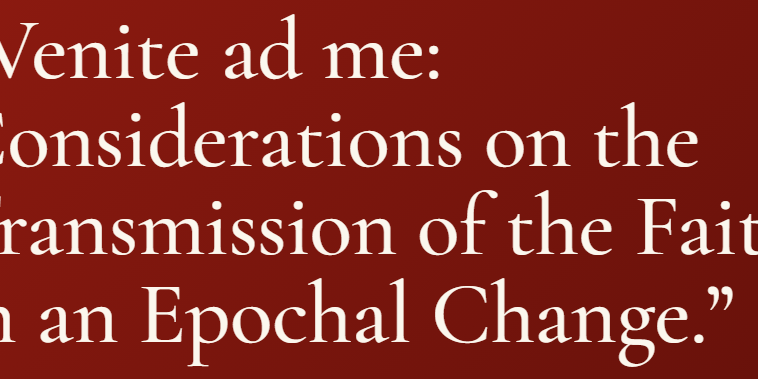
Venite ad Me, translated from the Latin as ‘Come to me,’ was published by the Dicastery for the Doctrine of the Faith on October 22, 2026, the memorial of St John Paul II. Signed by Cardinal Víctor Manuel Fernández and approved by Pope Leo XIV, it is subtitled Considerations on the Transmission of the Faith in an Epochal Change. It explores a question familiar to every Caribbean parent, catechist and priest: how do we hand on the faith when the old channels no longer carry it?
It begins not with statistics or a lament over secular culture, but with Christ, who draws near to each person “in the concrete circumstances of their life” (1). Transmission is an encounter before it is a programme.
What kind of document is this?
The Dicastery calls it Considerations, not a Doctrinal Note (cf 8): a pastoral meditation, enriched by reports from bishops’ conferences—our own Antilles Episcopal Conference among them. Its concern is fides qua, the living act of entrusting oneself to Christ, rather than fides quae, the content believed (5). It is a matter of order: no one can be formed in a faith to which they have never been introduced.
The Father’s love, revealed in Jesus
The first chapter is a portrait of Jesus the evangeliser. He “does not wait… He does not establish his own sanctuary or school. He moves about; he travels” (14). He cares especially for the “last” (17). His message fits on a child’s lips: God is love, forever and for everyone (10), even for those who condemned him. God’s “yes” in Christ “can never be transformed into a ‘no’” (20).
There is a prophetic edge. “No human or religious law or authority can ever declare anyone unworthy of his love” (18). A Church that wants to hand on the faith must ask whether its own habits—who is greeted at the door, who is noticed in the pews—proclaim that Gospel.
The kerygma: first in importance, not only in time
The heart of the document is the kerygma. Pope Leo XIV gave the Dicastery its charter in June 2025: “In a time of great fragmentation, it is necessary to return to the foundation of our faith, to the kerygma” (4). In Pope Francis’ words: “Jesus Christ loves you; he gave his life to save you; and now he is living at your side every day to enlighten, strengthen and free you” (75). Love, sacrifice, presence.
This proclamation is “first” not because we move past it but because it is the principal word, to be heard again and again. The document admits that many young people drift away right after Christian initiation or Catholic school (79). We taught them much; did we ever tell them, personally and warmly, that Jesus loves them and is alive at their side? It asks for a “performative” proclamation that sets hearts alight, as on the road to Emmaus (77).
That is what happened on Jim’s floor. No one explained the Cross to him; he discovered it as love. It is the oldest pattern there is. When Peter first proclaimed: “this Jesus whom you crucified,” his hearers were “cut to the heart” and asked, “What shall we do”? Peter’s answer: Repent and be baptised (Acts 2:36–38).
Why this matters for us
Caribbean Catholicism has long been carried by custom: the Christening, First Communion photographs, the funeral that the whole village attends. These are graces. But custom is no longer enough; faith, as the Chilean bishops put it, has become “a proposal that must be freely accepted” (63). That is also a liberation. Handing on the faith is not, at root, defending an institution. It is introducing a friend. Being Christian, Benedict XVI said, is “the encounter with an event, with a person who gives life a new horizon and a decisive direction” (24).
Two weeks after that Friday, I went back. Jim was different. He was asking questions: about God, love and forgiveness, about his family, about the way God works in our lives. His son was a few months old, and he asked me: “Father, how can I baptise this child”? So Jim, his child’s mother and I sat together and walked through the kerygma—that Jesus loves them, gave His life for them, and lives at their side—and then through what the Church believes. “I want my child to know Jesus Christ,” he said. We baptised the boy and welcomed him into the Church.
Christ’s first word to Jim was not “Do more,” or “Become better first”. It was “Come to me”. And it is the same word He speaks to every one of us who labours and is heavy laden.
In the next article we turn to the document’s frank account of why the chain of transmission has broken, and what that means for the Church in the Caribbean.
Key Message:
Handing on the faith begins with encounter, not a programme. The kerygma—Jesus Christ loves you, gave His life to save you, and is living at your side—is not a first lesson to be left behind but the principal word, to be heard again and again.
Action Step:
This week, go to one person carrying a heavy load. Sit with them first and listen. Then, in your own words, tell them that Jesus loves them, gave His life for them, and is with them today.
Scripture for Reflection:
Matthew 11:28