The third of four articles on Venite ad Me, the Dicastery for the Doctrine of the Faith’s Considerations on the transmission of the faith.
Peter, as I will call him, began life carrying a weight no child should carry. His mother died giving birth to him. As soon as the children around him were old enough to be cruel, they told him he had killed her. His father married again quickly. Peter grew up angry, awkward and hard to reach.
His grandmother raised him. She was a saintly woman, devout in the ways she knew. When she saw how much the boy was struggling, she did what generations of Trinidadian grandmothers have done.
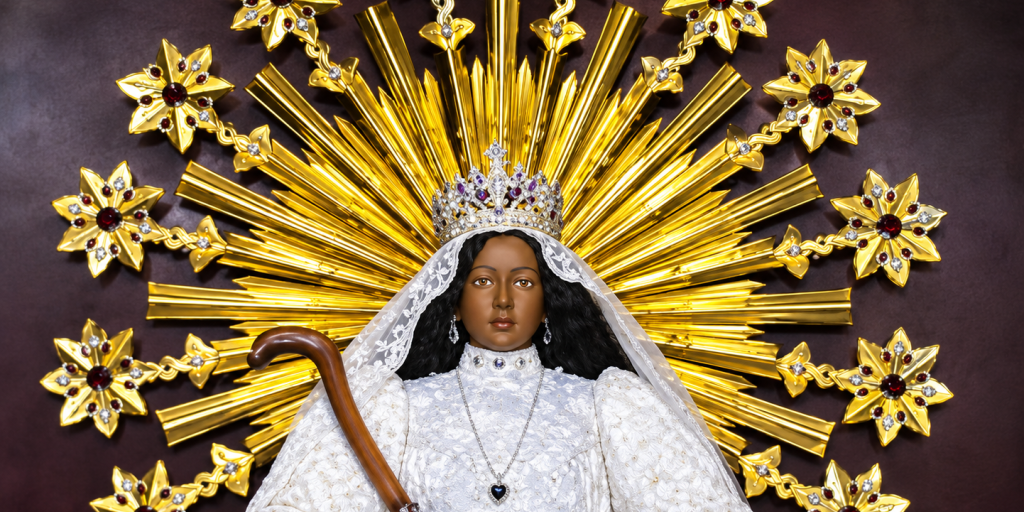
One Good Friday, she took him on a pilgrimage to nine churches, ending at Siparia for the three o’clock devotions, the hour Jesus died. There, before La Divina Pastora, the Divine Shepherdess whom many simply call Siparia Mai, she offered Peter to the Shepherdess and begged her intercession for this one troubled boy. She looks after all her children, the old people say.
She was not alone. Catholics filled the church in prayer. Hindu families had come too, as they have since the days of indentureship, to have their children’s hair cut for the first time on the church grounds. Others laid small gold figures at her feet, a hand, a foot, in thanksgiving for favours granted. To them she is Siparee Ke Mai, the Mother of Siparia.
The grandmother’s fervent prayer held Peter. It introduced him to a Mother who would not let him go, and through her to her Son. In that devotion, a motherless boy came to know he was loved, and faith settled in him. After the pilgrimage, Peter settled too, and slowly he was able to pick up his life.
It is no accident that the grandmother brought him to a Mother at that hour. From the Cross, Jesus gave His own Mother to the disciple He loved: “Behold, your mother!” And “from that hour the disciple took her to his own home” (Jn 19:27).
A boy told he had killed his mother was given another Mother, at the foot of the Cross, by the One who died for him.
In their own words
St Luke tells what happened next to the two Emmaus disciples. Hurrying back to Jerusalem, “they told what had happened on the road, and how he was known to them in the breaking of the bread” (Lk 24:35).
With a pilgrimage, a statue and a Mother’s name, Peter’s grandmother told the Gospel to a boy who needed it most: You are not abandoned; you are held.
Venite ad Me calls this the work of culture, and it is as old as the Incarnation. The Word became flesh (Jn 1:14) in one people, one language, one village, and He has been taking flesh in every people since.
The document quotes St John Paul II: “A faith that does not become culture is a faith that has not been fully embraced” (102). The Gospel must reach a people’s way of life deeply, “not in a decorative way”. And a people whose faith has become culture, in handing on its culture, hands on the faith too (104).
Faith, the document says, is passed on “in dialect” (36): the mother tongue of the heart, learned at a grandmother’s knee.
We have heard that dialect already in this series. When Jim asked, “Father, He really suffer all that for we?” he was not getting the kerygma wrong. He was saying it in the language of his own heart, and no catechism phrase could have said it better.
The Spirit speaks every language
The Church was born speaking many languages. At Pentecost, the crowd asked, “How is it that we hear, each of us in his own native language?” (Acts 2:8). Without the Spirit’s strength, as the Pentecost Sequence prays, “there is nothing in us” (23). The Spirit lets the one Gospel be heard in Kwéyòl in St Lucia, in Parang in Paramin, and in a grandmother’s whispered prayer at Siparia.
An honest history
Our history is not innocent. The faith reached these islands alongside conquest, the slave ship and the indenture contract. Yet we also have Bartolomé de las Casas, the colonist who became a defender of the Indigenous peoples.
Writing of Africa, the document warns that where the Gospel has not truly taken root in a culture, faith stays superficial, and people return to traditional practices (52). So the Church discerns. It recognises “seeds of the Word” in a people’s ways (Vatican II, Ad Gentes 11), purifies what needs purifying, and sets aside what cannot live with the Gospel.
We have received more than we know. At Siparia, the choir sang to the African drum, the chac chac and the tambourine as if they were simply ours, which they now are. The drum and its rhythm came with the peoples brought here from Africa; the chac chac with the First Peoples; the tambourine by way of Spain. Each has become part and parcel of our Catholic musical tradition. What was once despised now carries our praise.
Discernment must also be honest about us. When Catholics turn to the obeah man or the spiritual healer, the question is not only what is wrong with them. It is what they were looking for and failed to find in us: protection, healing, a community that takes their fears seriously.
Siparia shows how delicate this work is. Indian labourers, brought here under indenture between 1845 and 1917—far from home and often despised—found in that small dark statue a mother who seemed to understand them.
Their descendants still come on Holy Thursday and Good Friday, as the Church keeps watch at the Cross. The Church welcomes their devotion and honours the trust behind it. It does not pretend the two faiths are the same. For Catholics, Mary always points beyond herself: “Do whatever he tells you” (Jn 2:5).
Where God speaks
The document quotes Pope Francis: for those who can read them, such devotions are a locus theologicus, a place where God teaches us (Cf. 112). Think of what our people carry: the Good Friday walk to nine churches, candles on the graves at All Souls’, Parang through Advent, the climb to Mount St Benedict.
And it warns that a purely intellectual view of the Marian faith risks missing how the Gospel is often passed on, “in a mystagogical way: through symbols, experiences, trust, and affection” (144). Peter’s grandmother was a mystagogue who had never heard the word.
Music, the document says, “is like a bridge that leads us to God” (99), and the steelpan has carried many hearts across it. It also asks us to reach the communities the Gospel has not yet touched, migrants among them (106).
Many Venezuelans now among us grew up honouring the Divine Shepherdess under the same title in Barquisimeto. Capuchins from Venezuela brought her devotion to Siparia more than 250 years ago. She is waiting to welcome them.
Telling it again
The Emmaus disciples did not repeat a formula. They told what had happened to them, and the Church grew from that telling. Peter’s grandmother told it in her way.
Every generation must find its own words. That is the real question behind the broken chain: not only whether our children know the prayers, but whether the faith speaks to them in a language they recognise as their own.
In the final article, we go out into the public square: schools, neighbours of other faiths and fellow Christians.
Key Message:
The kerygma must take flesh in our own culture, in its piety, music and speech, honestly purified, so that handing on our way of life also hands on Christ.
Action Step:
This Advent, take a child or a friend to one devotion and tell them what it means to you.
Scripture for Reflection:
“Then they told what had happened on the road, and how he was known to them in the breaking of the bread” (Lk 24:35).